
BLOG
Metaphors, Minds, Technology & Learning
Note: The shared blogging experiment with Melissa Warr and Nicole Oster continues. This time we delve into metaphors of the mind, technology and generative AI. The core idea and first draft came from Melissa, to which I contributed a substantial rewrite. The final...
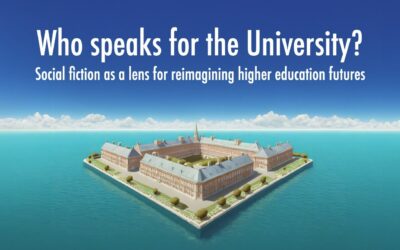
Who speaks for the university? Social fiction as a lens for reimagining higher education futures
Note: Image above created using Adobe Firefly, Photoshop and composed in Keynote. A few years ago, I had the pleasure of connecting with author Dr. Phoebe Wagner through the Center for Science and the Imagination at Arizona State University. We discussed her...
Why are we surprised? Hallucinations, bias and the need for teaching with and about genAI
By Punya Mishra, Melissa Warr & Nicole Oster Note: This is the first post in an experiment at shared blogging by Melissa Warr, Nicole Oster and myself. Over the past months we have found ourselves engaged in some fascinating conversations around genAI, education,...

SITE 2024: A recap
The Society for Information Technology in Teacher Education (SITE) conference has been an integral part of my professional journey for over two decades. My first presentation at SITE was back in 2001 with Matt Koehler and through the years, SITE has played a pivotal...
AI in Education: Potentials, Perils & Policies
NORRAG, based at the Geneva Graduate Institute, is a global network focused on international education policy and cooperation, known for its commitment to addressing under-researched topics related to education quality and equity and amplifying voices from the Global...
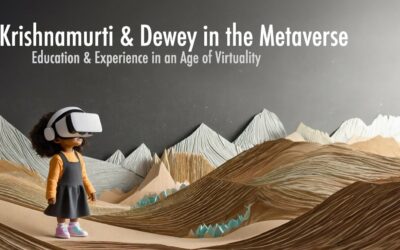
Krishnamurti & Dewey in the Metaverse: Education & Experience in an Age of Virtuality
What does it mean to have an educative experience? As Dewey famously wrote: The belief that all genuine education comes about through experience does not mean that all experiences are genuinely or equally educative ~ John Dewey Questions such as these come to...
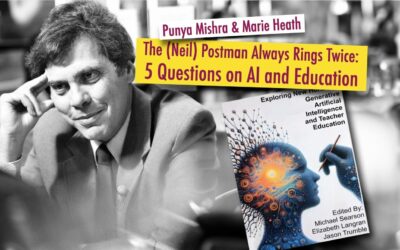
The (Neil) Postman Always Rings Twice: 5 Questions on AI and Education
Note: This post has also been cross-posted on the Civics of Technology blog. Marie Heath (with whom I recently co-wrote a blog post about GenAI in Teacher Education: A techno-skeptical perspective) and I were invited to write a chapter for an edited volume titled...
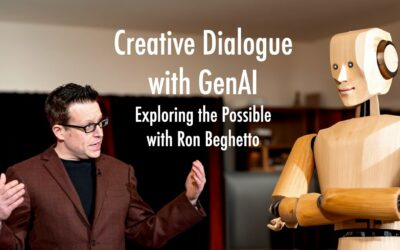
Creative dialogue with Generative AI: Exploring the Possible with Ron Beghetto
As part of our ongoing series for the journal TechTrends exploring the intersections of technology, education, and creativity, we have recently turned our focus to the potential impacts of generative AI (GenAI) on these domains. Our latest article features a...
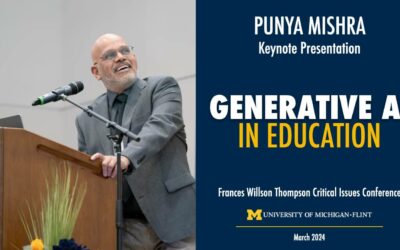
Generative AI in Education: Keynote at UofM-Flint
A couple of weeks ago I was invited to give a keynote at the Frances Willson Thompson Critical Issues Conference on Generative AI in Education. It was great to go back to Michigan even if for a super short trip. One of the pleasures of the visit was catching up with...
Generative AI: Will history repeat or (just) rhyme
As generative AI continues to reshape our world, we're faced with a crucial question: Will we repeat the mistakes we made with previous technologies or will this time be something different? George Santayana famously warned, "Those who cannot remember the past are...

Hype & Luck: Gratuitous Self-Promotion (2024 Edition)
It is natural, if you have been working in a field for a while, and have been somewhat successful, that some accolades will come your way, just by dint of being around long enough. As Bing Chat wrote, when asked to create a funny, self-deprecating profile of me in the...
GenAI in Teacher Education: A Technoskeptical Perspective
Image created using Adobe Firefly & Adobe Photoshop, composed in Keynote by Punya Mishra By Marie K. Heath and Punya Mishra Hello! This is a cross-blog post between Punya Mishra’s blog, where he plays with ideas of learning, technology, design and creativity...

“Tipping” the Scales: When Metaphors (Quite Literally) Blur Reality
Should we tip machines for the work they do for us? Does that question even make sense? What follows is a reflection on metaphors, technology, deceptive design, AI and more... Read on. Metaphors and more In her book God, Human, Animal, Machine, Meghan O’Gieblyn...
Generative AI, Teacher Knowledge and Educational Research: Bridging Short- and Long-Term Perspectives.
I am pleased to share our latest article in our ongoing column series for TechTrends on the topics of technology creativity and education. Over the past few months we have focused on generative AI, through conversations with thought leaders such as Chris Dede...
Media, Cognition & Society through History: A Mapping
If oral cultures prioritize memory and print cultures emphasize systematic organization, what types of knowledge will AI systems foster? Marie Heath and I wrote this line in a chapter that is currently in press. But the idea underlying this quote has been with me for...
Blast from the past: Technology, representation & cognition
I published my first academic article (a book chapter) in 1996 when I was a PhD student at the University of Illinois at Urbana Champaign. My the advisor, Rand Spiro, had been invited to write a chapter for an edited book and asked me if I would be willing to join him...

The Absurd One-Sidedness of the Ethics of AI Debate: A rant
It seems no conversation about AI and education is complete without discussing the importance of the ethical use of the technology. There are numerous reports and academic articles about it (this and this and this ... I could go on and on). There is, however, one...
It HAS to hallucinate: The true nature of LLM’s
Though Generative AI is receiving a great deal of attention lately, I am not entirely sure that the discussions of these technologies and their impact on education and society at large genuinely engage with the true nature of these technologies. In fact I have argued...
Education & the Rise of AI Influencers
I have been thinking hard about the nature of generative AI, what sets it apart from other technologies that have come in the past. It seems to me there are two key factors. The first is its ability to engage in dialogue, in natural language and the second are its...
Reflection: Welcome 2024
Since December 2008 we have been creating a video to welcome the new year. When we made our first video we had no idea that we would still be doing it 16 years later, and, frankly who knows how long we can keep it up. These videos are usually typographical in nature,...
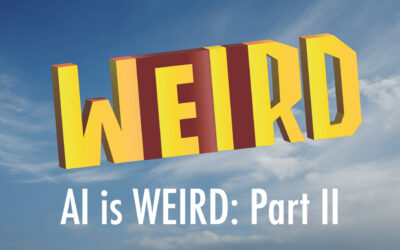
AI is WEIRD: Part II
Note: The image above is an original design - showing "AI" embedded in the word "WEIRD" Generative AI is weird... as I had written in my previous blog post, identifying some key characteristics I had described in a recent Keynote presentation. In the process of...

GenAI 2023: Year in Review
A week or so ago I was joined by friends Sean Leahy, Rachna Mathur and Kellie Kreiser on the Learning Futures Podcast. The topic: looking back on a crazy, dynamic, transformative year of generative AI. As is to be expected, we covered a lot of ground in the...
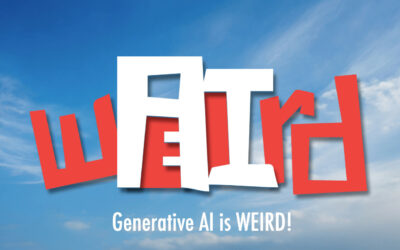
Generative AI is WEIRD!
Note: This blog post was almost entirely written by ChagGPT based on an analysis of a set of images I had uploaded onto it. The image above (Weird AI) is an original typographic design created by me. The background sky was created by Adobe Firefly. To give some...
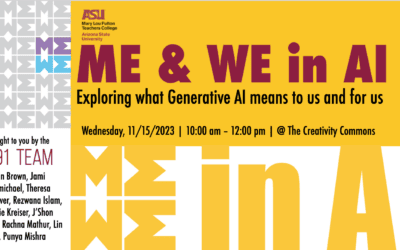
Me & We in AI
What does generative AI mean to me? And to us? These key questions were part of a special exhibit curated by students in the DCI 691: Education by Design course I taught this fall. Education by Design is my favorite class to teach. It is a course about design—design...
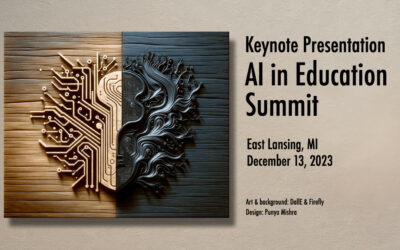
Keynote Presentation: AI in Education Summit
Note: The image above is the result of a two-stage creative process—done in collaboration with AI. Dall-E was tasked, over multiple iterations, to craft a woodcut-style image, to abstractly capture the idea of AI and education, with dark and light motifs, aiming to...
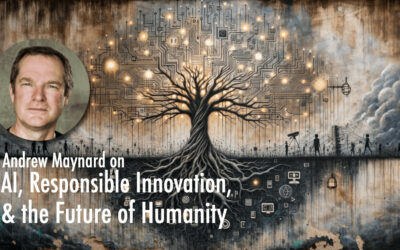
Andrew Maynard on AI, Responsible Innovation & The Future of Humanity
Welcome once again to our ongoing column series where we delve into the intersection of technology, creativity, and education. Our conversations with authorities such as Chris Dede (Harvard), Ethan Mollick (Wharton), and Kyle Jensen (ASU) have centered around the...
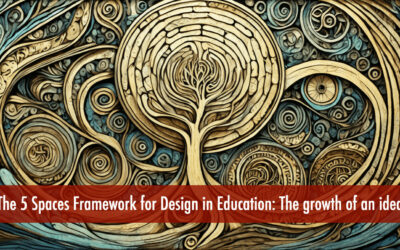
The 5 Spaces Framework for Design in Education: The growth of an idea
The Five Spaces for Design in Education framework argues that design in education happens in 5 interrelated spaces: artifacts, processes, experiences, systems and culture. We have typically represented this as follows. Over the past years we have published and...

Contemplating Design: Remixing the 5 spaces framework
The Five Spaces for Design in Education framework argues that design in education happens in 5 interrelated spaces: artifacts, processes, experiences, systems and culture. We have typically represented this as follows. We, however, are also very aware that any...
AI writes book reviews
Here is the title and abstract for a book review that was just published in the Irish Journal of Technology Enhanced Learning Preparing Ourselves for Artificial Intelligence: A Review of The Alignment Problem and God, Human, Animal, Machine Abstract: In this article,...
OECD Global Forum on the Future of Education: Bucharest, Romania
I have been in Bucharest for the past few days participating in the OECD Global Forum on the Future of Education. It has been great fun, meeting lots of new people, developing frameworks around AI and education and more. A few resources and photographs from the...