Around a year ago (January 27, 2025) I got an email out of the blue from Raaghav Pandya, introducing himself as a scholar working at intersections of STEM, creativity, makerspaces, South Asian pedagogical traditions, and youth wellbeing, and seeking to connect. I was...
The Overconfident Intern in the Classroom: Reflections on AI, TPACK, and Education
I recently joined Justin Hardman on the Education Vanguard podcast for a conversation that ranged from the evolution of TPACK (now over 20 years old) to what AI actually means for teachers and learners. Justin and I go back a long way: he hosted me for a keynote at...
From HTML to GenAI: Re-visiting Three Early-Web Projects
I've been on a bit of a vibe-coding spree lately, building interactive simulations, educational tools, cultural experiments, all through conversation with AI rather than traditional programming. At some point I looked up and thought: what about the stuff I made back...
Creativity & AI: On the Perkins Platform Podcast
I recently joined Dr. Brian K. Perkins on the Perkins Platform Podcast for a conversation that gets at a question I think about a lot: when AI is part of the process, what actually qualifies as your work? In our conversation we pushed back on the tired extremes and...
Social-Emotional Learning & AI at LERN2026
Social-Emotional Learning & AI at LERN2026 Our team presented two papers at the 2nd Annual Learning Engineering Research Network (LERN) Convening, held February 3–4, 2026, at ASU's Tempe campus. The convening, themed "From Insights to Implementation: Learning...
What a Guide to AI in Schools Reveals (and What It Can’t)
We had Justin Reich and Jesse Dukes as guests on the Silver Lining for Learning webinar/podcast to discuss their new guidebook, A Guide to AI in Schools: Perspectives for the Perplexed. The resource, based on over 120 interviews with teachers and students, offers a...
AI, Education, & the Unregulated Global Experiment: Keynote at Education International’s First Global AI Conference
I recently had the privilege of speaking at Education International's inaugural Global Conference on Artificial Intelligence: Shaping our Future: Education Unions Leading for a Human-Centred AI, held in Brussels on December 4–5, 2025. More than 200 union leaders,...
How do people think AI works? (Some surprising findings)
Those of us who work in and around artificial intelligence often exist in something of a bubble. We talk about vibe coding and hallucination rates as if these concepts are common knowledge. I have often wondered about how much the broader public understands about how...
An AI Premortem: A New Direction for Students in an AI World
When social media first entered our world, educators—myself included—focused narrowly on strategies for incorporating these tools into classroom contexts. We were so busy figuring out the "how" of implementation that we paid far less attention to the "what if" of...
The Curiosity Paradox: How Sycophantic GenAI May Undermine Learning
Over the years, our column series in TechTrends has explored the intersections of creativity, education, and emerging technologies. Over the past year, we've examined GenAI's impact through interviews with leading thinkers, practitioner studies, and conceptual pieces...
Remembering John Langdon
John Langdon (website | wikipedia) passed away a few days ago, on January 1, 2026. He was one of the pioneers of ambigrams: words designed to be read from multiple orientations, most commonly upside down. We never met. There were opportunities but somehow it never...
The Parrot’s Tale, Updated
I'm in Bangalore this week for Quest Alliance's Quest to Learn 2025 conference. Looking back through my blog, I found that my first encounter with Quest was in 2008, and again in 2018. In that 2008 post, I had written about a talk by Geetha Narayanan where she read...
The Plays I Never Saw: A Tribute to Tom Stoppard
Tom Stoppard, the renowned playwright, has died. The funny thing is that I never saw any of his plays performed. And yet he played a critical role in making me who I am. The fact that I knew this playwright by reading his plays, rather than seeing them on stage, may...
The Freedom to Design: Repurposing Technology for Creative Teaching
I recently had the pleasure of joining Dr. Cyndi Burnett and Dr. Matthew Worwood on the Fueling Creativity in Education podcast for a wide-ranging conversation about teachers, technology, and creative agency. We explored a question I've been thinking about for years:...
TPACK Handbook 3rd Edition (Plus: Covers that didn’t make it)
Twenty years. That's how long it's been since Matt Koehler and I published the 2006 article that gave the TPACK framework its name. The core ideas have aged reasonably well, even as the technologies around us have shape-shifted in ways we never anticipated. What we...
GenAI & Trans-disciplinary Creativity: New Book Chapter
What does the advent of AI mean for human creativity? That is the focus of a new book, Generative Artificial Intelligence and Creativity: Precautions, Perspectives, and Possibilities, edited by Matthew J. Worwood and James C. Kaufman. And as it happens, Danah...
Making Thinking Visible: Some Examples of No-Code (Vibe) Coding
I was thrilled recently when my friend Josh Brake mentioned me in his Substack post about "The Forward Deployed Educator." He referenced the Unit Circle Demo I had created and wrote about how educators can now use AI tools to build custom learning experiences for...
Blaming the Parents, Not the Platforms: How a World Bank Screen-Time Report Lets the Attention Economy Off the Hook
Note: This is a cross post with the Civics of Technology blog. The World Bank recently released a report titled Balancing the Digital Scales: Screen Time Management in Early Childhood Education (Molina, 2025). The report lays out how excessive screen exposure in young...
The Real AI Challenge: Building Systems That Adapt, Not Just Adopt
“The environment is where we all meet, where we all have a mutual interest; it is the one thing all of us share. It is not only a mirror of ourselves, but a focusing lens...” ~ Lady Bird Johnson “A system is never the sum of its parts; it’s the product of their...
Einstein’s Beams and Feynman’s Colors: What We Lost When We Debunked Learning Styles
“When I see equations, I see the letters in colors — I don’t know why. As I’m talking, I see vague pictures of Bessel functions from Jahnke and Ernde’s book, with light-tan j’s, slightly violet-bluish n’s, and dark brown x’s flying around. And I wonder what the hell...
Beyond Skills: A conversation on Futures & Learning
A few months ago I sat down with my friend Bhawna Parmar as a guest on the Quest for Better Futures podcast. Readers of this blog will remember Bhawna from her insightful article in The Caravan that had inspired a previous blog post: While we weren't looking: The real...
The Promise and Paradox of Creative AI: Talk at U25 Conference
I was recently invited to speak at the Universel Conference 2025: Empowering Humane Technology. You can find the abstract, and an embedded video of my talk below. The Promise and Paradox of creative AI What happens when an AI can write a mathematically perfect poem,...
We Are All Living in Searle’s Chinese Room
I found out a couple of days ago that the philosopher John Searle passed away on September 17, just a couple of weeks ago. Searle was a philosopher known for his work in the philosophy of language, philosophy of mind, and social philosophy. That said, he most known...
Subversion as Literacy: Foreword in “Critical AI in K-12 Classrooms”
A little less than a year ago, my friends and colleagues, Marie Heath and Stephanie Smith Budhai reached out to me asking me if I would be willing to write a foreword to their book Critical AI in K-12 Classrooms: A Practical Guide for Cultivating Justice and Joy. I...
From the Archives: My First Paper on Design
Earlier today I had a Zoom call with a doctoral student interested in having me on her comprehensive examination committee. During our conversation, she expressed interest in understanding the idea and process of design, particularly as it applies to educational...
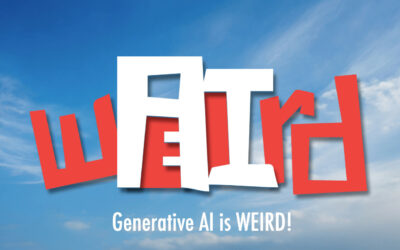
LLMs are WEIRD Stochastic Parrots
Almost exactly a year ago, I wrote about how AI systems trained on WEIRD (Western, Educated, Industrialized, Rich, and Democratic) data risk creating a flattened, culturally homogenized version of human psychology. In my post (titled, S’more problems: Generative Ai,...
While We Weren’t Looking: The Real Digital Revolution Beyond School Walls
What is the role of technology in learning? I have devoted a large part of my professional life to this question, though I have increasingly started to wonder whether we, personally, and as a field, have been asking the wrong question. We have focused our attention on...
Whose Voice? Whose Accent? Navigating Authenticity & Impact in AI-Generated Content
I've had the pleasure of co-hosting the AIR|GPT podcast, where I've gotten to know Errol St. Clair Smith as one of the most thoughtful curators of education-related news and information I've encountered. Errol has this uncanny knack for bringing diverse voices...
The perfectly wrong person for the job: My essay on the future of the orchestra
Note to readers: This is the story of how I came to write an essay called "Why Gödel and Escher But Not Bach" for a book about the future of orchestras. I should add that I know almost nothing about orchestras and feel deeply uncomfortable in public classical music...
On Becoming: Insights from the Modem Futura Podcast
I recently had the pleasure of returning to the Modem Futura podcast for a second conversation with hosts Andrew Maynard and Sean Leahy, and guess what, it was even more fun than the first time around. What started as a discussion about the latest AI developments in...