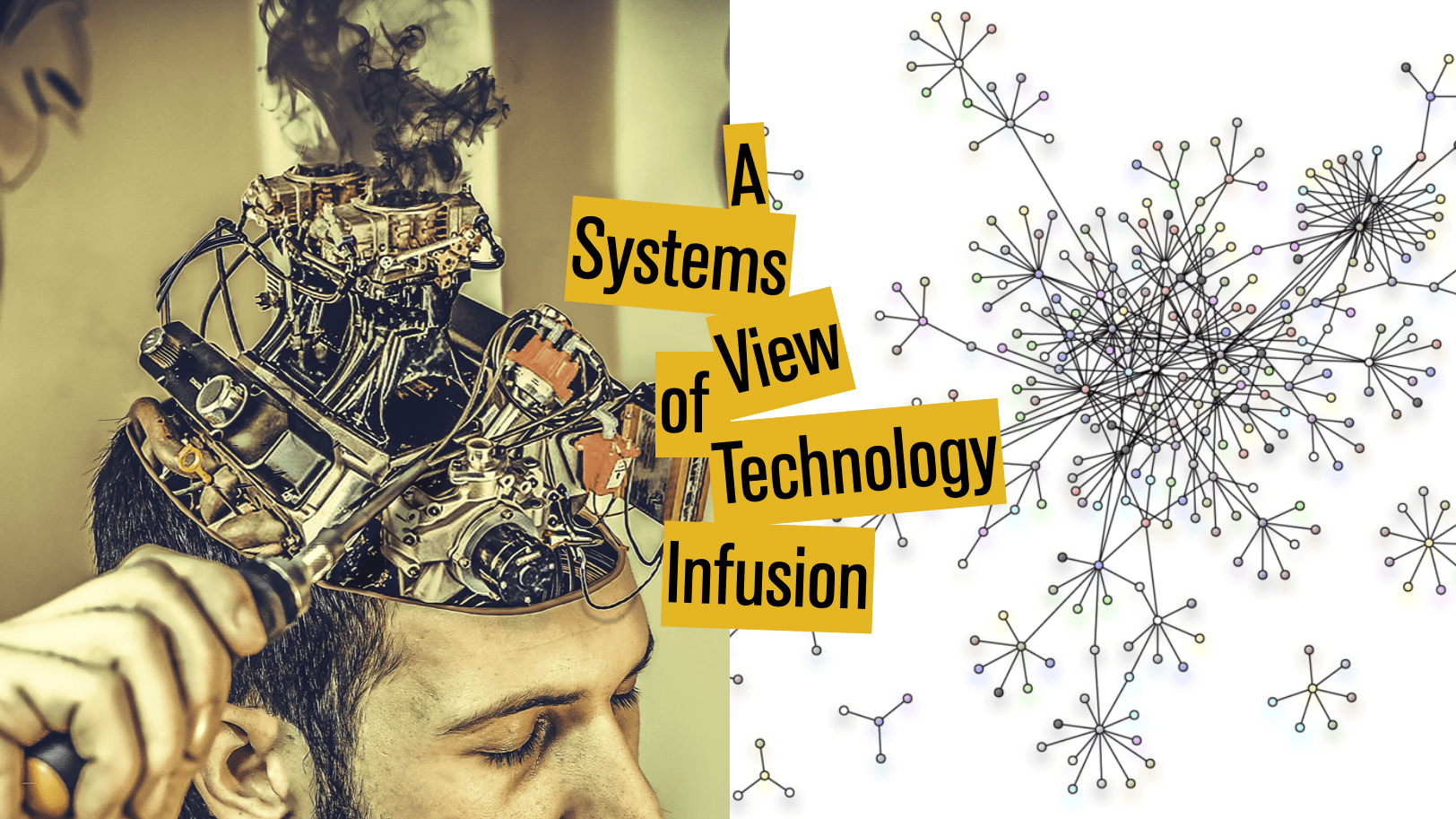
A systems view of technology infusion

by | Monday, June 22, 2020

One of the significant changes in my way of thinking about technology integration has been a shift in focus—away from designing training and programs that target individual teachers to designing systems (both at K12 and higher education levels) that support teachers in the work they do. This does not minimize any way the teacher knowledge work I have done (aka TPACK framework) but it does situate that line of work within a bigger frame. This is consistent with my work on the 5 spaces for design that I have written about earlier. (More on that below.)

When Arelen Borthwick, Teresa Foulger and Kevin Graziano invited me to write a foreword for a book on technology infusion I decided to bring this broader frame into the discussion. In writing that foreword, Melissa Warr and I, expanded on a fun blog post I had written (Game of Thrones meets Toyota: 2 examples of systems thinking). More details below.

Borthwick, A. C., Foulger, T. S. & Graziano, K. J. (2020). Championing technology infusion in teacher preparation: A framework for supporting future educators. International Society for Technology in Education.

The publishers have made the table of contents and foreword freely available. Complete reference to foreword below.

Mishra, P., & Warr, M. (2020). Foreword: A Systems View of Technology Infusion. In A. C. Borthwick, T. S. Foulger, & T. S. Graziano, (Eds). Championing technology infusion in teacher preparation: A framework for supporting future educators. International Society for Technology in Education. (p. xvi-xxii).

For more information about the 5 spaces for design please see links below:

A few randomly selected blog posts…

Mishra & Girod (2006/2007)

Mishra, P., & Girod, M. (2006/2007). Designing learning through learning to design. The High School Journal. 90(1). 44 – 51. Reprinted in K. M. Cauley, & G. Pannozzo, (Eds.), Annual Edition: Educational Psychology 07/08. McGraw-Hill: NY. Abstract: This paper...

Using AI to digitally clone myself (AKA creating a Puny-Punya)

Using AI to digitally clone myself (AKA creating a Puny-Punya)

Note: The photo-manipulated image of me holding my own head was created almost 20 years ago by Paul Kurf, a student in my learning by design, class! Image design & layout, Punya Ethan Mollick is a professor at Wharton and he has been doing some of the most...

Gender & GPS

During our recent NY / New Jersey visit (during the kids spring break) I had the first opportunity to drive a car equipped with a GPS system. It was a case of love at first sight. I got back home and bought myself a Tom Tom right away. I used this unit extensively...

The ELIZA Effect-ion

The ELIZA Effect-ion

NOTE: This is a cross post with the Civics of Technology blog. I first read about the "ELIZA Effect" as a high-school student in India, in Douglas Hofstadter's classic rumination on art, music, humanity and AI—Gödel, Escher, Bach: An Eternal Golden Braid.. The...

A long view of knowledge

I should really visit Salon.com more often. Every time I go there I find something interesting, challenging and thought provoking. My recent foray there led me to a book review written by Laura Miller (The road to Wikipedia). Miller reviews "Reinventing Knowledge:...

Me & We in AI

Me & We in AI

What does generative AI mean to me? And to us? These key questions were part of a special exhibit curated by students in the DCI 691: Education by Design course I taught this fall. Education by Design is my favorite class to teach. It is a course about design—design...

The Loss of Nuance in discussions of AI in Education

The Loss of Nuance in discussions of AI in Education

In which I respond thoughtfully to a journalist's question about AI in schools, watch my nuanced argument get reduced to a single quote, and reflect on how complexity gets flattened at multiple levels—from educational policy to media coverage. I recently wrote a post...

Dancing with words, Good/Evil in a new ambigram context

Many years ago I constructed an ambigram for the words "good" and "evil." The idea came to me while waiting for a traffic light to turn green. The memory of it is so vivid in my mind that even today when I come to that particular intersection I remember that moment...

The benefits of doodling!

Finally science has proved what I knew all along, doodling is a sign of an alert mind and may actually help memory!! Another justification for this, I guess.

0 Comments

Submit a Comment

Your email address will not be published. Required fields are marked *