Goodbye 2020 (whew), welcome 2021

by | Thursday, December 31, 2020

2020 has been a heck of a year… and maybe in hindsight (hindsight, of course, being 2020) it will all make sense. But, I think we can all agree that it is time to let it go.

A lot has changed this past year but one tradition we wanted to keep alive was the short videos we create to welcome the new year—a family tradition since 2008. Our videos are usually typographical in nature with some kind of an AHA! moment built in. This year’s video is somewhat different in that it is entirely created on the computer. This is something we have resisted doing since a large part of the fun has been designing the props and the process of shooting/editing to create the final video. However, as my friend Neelakshi pointed out, in some ways it is fitting that this year’s video should be entirely created on a computer since that’s where we did everything!

Check out the latest video, saying goodbye to 2020 and welcoming 2021. May this year be one of joy and peace for all.

You can see all the previous years’ videos here. As you can see we have had a lot of fun over the years.

The idea behind the video?

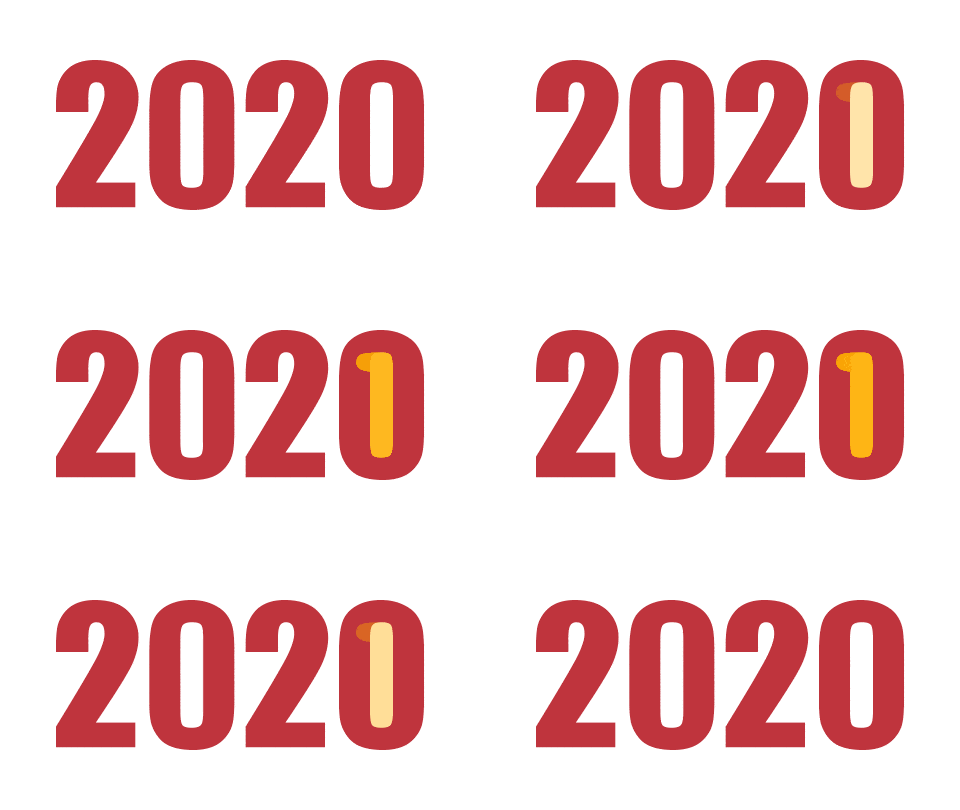
The video hinges on writing the word “zero” in such a way that it reads “one” when rotated by 180 degrees.

Such designs (that let you read words in more than one way) are called ambigrams. You can learn more about ambigrams (and the underlying mathematical ideas behind these designs) here or by watching the video below.
Topics related to this post: Aesthetics | Ambigrams | Art | ASU | COVID19 | Creativity | Design | Fun | Games | Mathematics | Personal | Puzzles | Video | Worth Reading

A few randomly selected blog posts…

Designing learning in a transformed world: Keynote

Designing learning in a transformed world: Keynote

I was recently invited to present virtually at The Heart of Innovation Summer Summit, organized by the Heartland Area Education Agency in Iowa. The video of my talk can be seen below. Maybe my first serious keynote talk about generative AI and education. Enjoy...

On merging with our technologies (Unpacking McLuhan 4/3)

On merging with our technologies (Unpacking McLuhan 4/3)

This is the fourth of what was supposed to be a three post-series about how media influence our thinking. The first post, uses the invention of writing and print to unpack the meaning of McLuhan’s statement, “The medium is the message.” The second post, focuses on a...

AERA 2013 – San Francisco, Photos

AERA 2013 - San Francisco, a set on Flickr.Photographs from the annual meeting of the American Educational Research Association (AERA) 2013 at San Francisco. It was great meeting up with friends and colleagues, present two talks and take in some of the sights. Enjoy.

TPACK at Classroom 2.0

There is an ongoing discussion at Classroom 2.0 on TPACK. You can join the conversation here.

Games, claims, genres & learning II

Aroutis Foster and I recently published a chapter in the Handbook of research on effective electronic gaming in education (I had posted about it earlier here). The handbook seeks to provide a comprehensive coverage of the use of electronic games in multiple fields....

Twittering a tale

My favorite short short story is by Hemmingway. It is all of six words long - but boy, does it pack a punch. It goes, "For sale, baby shoes, never used." Wow! It turns out that such short stories are not merely a novelty. The advent of Twitter and microblogging, with...

Virtual speed bump

Optical illusions are usually seen as being cool visual tricks, an intriguing way of peeking into how our brain works. They have rarely been considered to be functionally useful. Here is an exception: an optical illusion seen as a virtual speed bump! Check it out...

Handbook of TPCK

Handbook of Technological Pedagogical Content Knowledge (TPCK) for Educators, Edited by The AACTE Committee on Innovation and Technology
A Co-Publication of Routledge/Taylor & Francis Group and the American Association for Colleges of Teacher Education

Buy it at Amazon.com (Now available!)

This handbook addresses the concept and implementation of technological pedagogical content knowledge — the knowledge and skills that teachers need in order to meaningfully integrate technology into instruction in specific content areas.

3 Comments

  1. Marsha Woodbury

    I am so grateful to have my eyes opened to all the creativity. What a great brain, and thanks for sharing with us!

    Reply
  2. Shenglan Zhang

    I enjoyed watching it, Punya! Smita seems forever in her early thirties! Happy New Year!

    Reply
  3. Chris Pineson

    Well, 2020 now has officially gone, and all I want is 2021 could be much better, hope no more COVID-19, hope no riot in US, hope no flood in China, hope no earthquake, hope no wildfire in Australia. 2021 please treat all the mankind better.

    Reply

Submit a Comment

Your email address will not be published. Required fields are marked *