
Research: Aesthetics & learning
Why Aesthetics?
A child’s first experience, of peeking through a telescope to see the vivid sharply etched, yet fragile, rings of Saturn is a powerful one; perhaps as powerful as standing amidst redwood trees listening to the sound of wind rustling through the leaves or experiencing a moment of clarity when an elegant geometrical proof, surprising in its simplicity, emerges from a chaos of sketches and doodles. It is in this sense of awe and wonder that our minds nibble at confronting powerful ideas such as infinity (whether the infinity of numbers, or the interminably large scale of the cosmos, or the immeasurably small universe of cells and atoms and quarks). The emotional turbulence that overwhelms us when we reflect on nature, truly understand a scientific idea, or solve a tricky mathematical or engineering problem often leads to powerful aesthetic experiences. These experiences, we argue, are no different or less than the aesthetic experience we have in engaging with powerful artistic human creations, be it music or the visual arts.
That said, the role of the aesthetic has often been ignored in the discussion on learning. And I truly believe that is a huge mistake on our part.
On designing aesthetic educational
experiences in science
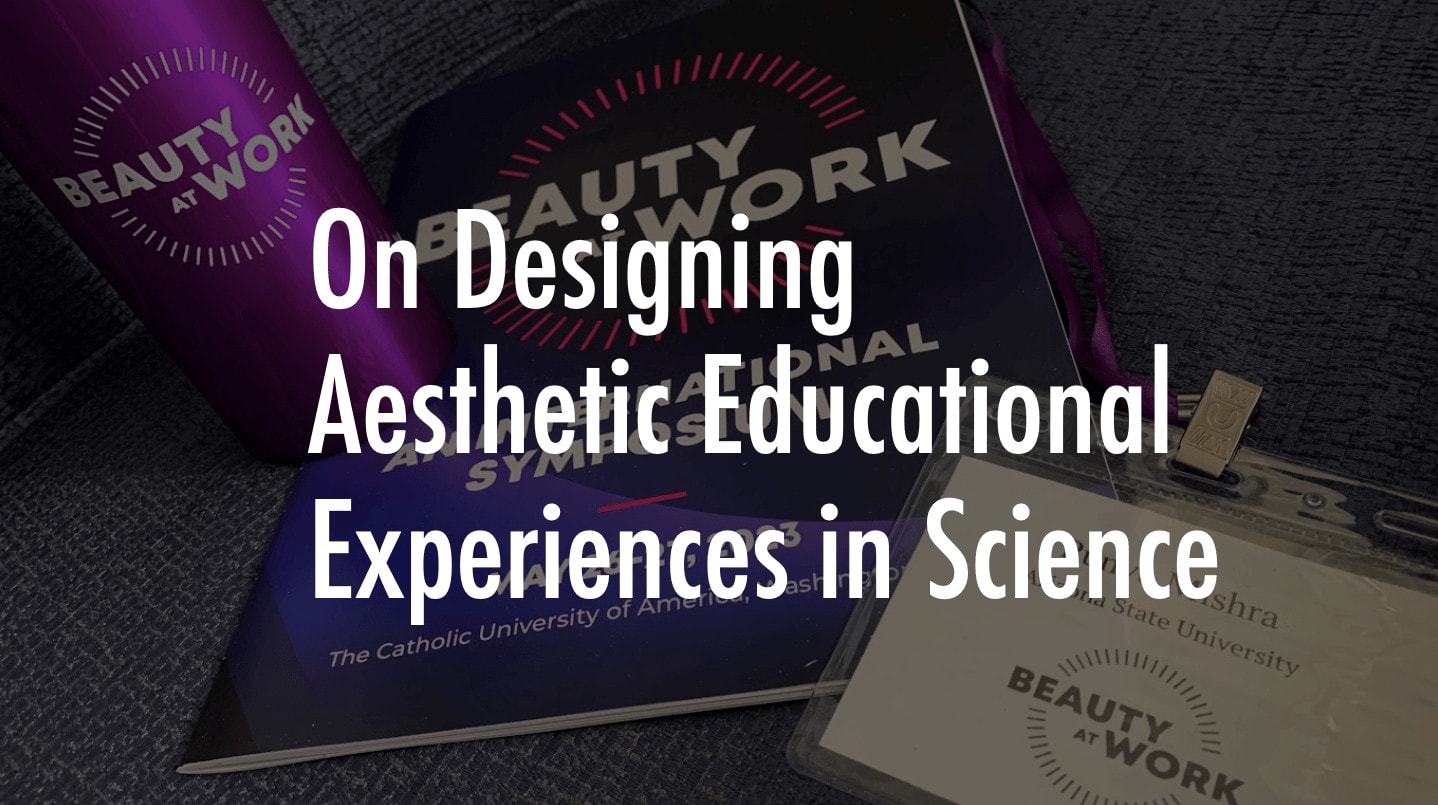
I was invited to give a presentation on this topic at conference titled Beauty at Work: An International Symposium at the Catholic University of America, in Washington DC (May 2023). I was part of a session on Aesthetic Properties and Scientific Information, along with Myron Penner (a philosopher of science from Trinity Western University); Amanda Nichols (professor of chemistry from Oklahoma Christian University); Milena Ivanova (from Fitzwilliam College, Cambridge); and Rebecca Kamen (artist in residence at the University of Pennsylvania). More details about the conference and a video of my talk (On designing aesthetic educational experiences in science) can be found here.
Aesthetics & coding
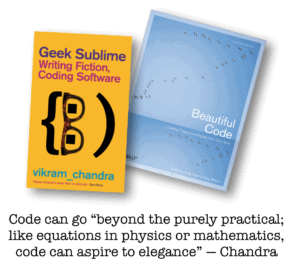
Does beauty have a role to play in learning to code? Can code aspire to beauty and elegance? In this article (Good, Keenan, & Mishra, 2016, titled Education:=Coding + Aesthetics), we argue that it does and it should.
Mathematical poetry

What does mathematics have to do with poetry? Not much, at one level, but a lot at another. Though their goals may be different, both mathematicians and poets play with structure and form, seek elegance and parsimony in their work. And in their own way they strive for truth and beauty—defined within the rules and structures of their discipline. I have loved both mathematics and poetry – with little or no success in each. But over the years I have played little games with both and some of these explorations are presented here.
Why aesthetics is essential (for science education)
Beauty at Work is a podcast that “explores how beauty shapes our lives and the work that we do” hosted by Brandon Vaidyanathan, Associate Professor of Sociology at The Catholic University of America. In its first season the focus is on beauty in science. As part of this series, Brandon has spoken with physicists, philosophers, psychiatrists, neuroscientists, entrepreneurs, psychologists and more. I was lucky to be a guest on this podcast, in an episode titled: Why Aesthetics is Essential for Science Education.
Why Teachers should care about beauty

In the article for the journal iWonder (Why teachers should care about beauty in science) – we explored the role of beauty in science education. In this piece, targeted at science educators, we use research in science education to highlight the importance of teachers consciously making connections to aesthetic aspects of science. Caring about beauty in science can inspire a sense of wonder and curiosity.
Aesthetics and STEM education
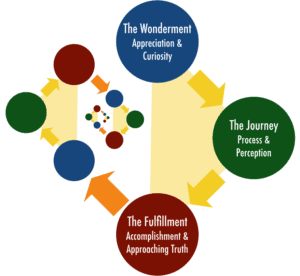
Developing a Rhetoric of Aesthetics: The (Often) Forgotten Link Between Art and STEM is an article that digs into these ideas in depth. In essence, this article is an extended argument that builds on several lines of work including philosophy, psychology, history and biography, in order to promote a model of learning based on aesthetic ways of knowing, thinking, and exploring the world. This emphasizes key impulses that make us human. We provide a generative three-fold fractal framework that seeks to capture the entire cycle of engaging in STEM practices: from curiosity to the process of seeking answers, to a sense of completion that in turn leads to new curiosities to explore. We suggest that this leads to a powerful virtuous cycle that seeks to maintain the same sequence at different levels of learning—from the beginner to the professional scientist, mathematician, or engineer.
Of Art & algorithms

In a couple of articles (most importantly Mishra & Yadav, 2013 and Evans, Henriksen, & Mishra, 2019) we argue that the partnership of deep human content knowledge with new technological advances can lead to deeper and more profound creative insights. We explore how computational thinking, combined with deep knowledge of a discipline, can lead to creative solutions that could not have been possible before. Thus the creative output is not determined by only the individual or the technology, but rather through a “partnership” between the two.
Blog posts related to aesthetics, beauty and learning
Working with constraints: Creativity through repurposing
Teaching is an inherently creative act, requiring educators to navigate constraints and find innovative ways to engage students. In our recently published chapter, Danah Henriksen, Lauren Woo and I explore the notion of "repurposing" as a vital skill for fostering...
Who speaks for the university? Social fiction as a lens for reimagining higher education futures
Note: Image above created using Adobe Firefly, Photoshop and composed in Keynote. A few years ago, I had the pleasure of connecting with author Dr. Phoebe Wagner through the Center for Science and the Imagination at Arizona State University. We discussed her...
Creative dialogue with Generative AI: Exploring the Possible with Ron Beghetto
As part of our ongoing series for the journal TechTrends exploring the intersections of technology, education, and creativity, we have recently turned our focus to the potential impacts of generative AI (GenAI) on these domains. Our latest article features a...
“Tipping” the Scales: When Metaphors (Quite Literally) Blur Reality
Should we tip machines for the work they do for us? Does that question even make sense? What follows is a reflection on metaphors, technology, deceptive design, AI and more... Read on. Metaphors and more In her book God, Human, Animal, Machine, Meghan O’Gieblyn...
AI is WEIRD: Part II
Note: The image above is an original design - showing "AI" embedded in the word "WEIRD" Generative AI is weird... as I had written in my previous blog post, identifying some key characteristics I had described in a recent Keynote presentation. In the process of...
Me & We in AI
What does generative AI mean to me? And to us? These key questions were part of a special exhibit curated by students in the DCI 691: Education by Design course I taught this fall. Education by Design is my favorite class to teach. It is a course about design—design...
Contemplating Design: Remixing the 5 spaces framework
The Five Spaces for Design in Education framework argues that design in education happens in 5 interrelated spaces: artifacts, processes, experiences, systems and culture. We have typically represented this as follows. We, however, are also very aware that any...
AI writes book reviews
Here is the title and abstract for a book review that was just published in the Irish Journal of Technology Enhanced Learning Preparing Ourselves for Artificial Intelligence: A Review of The Alignment Problem and God, Human, Animal, Machine Abstract: In this article,...
Questioning Assumptions: Podcast episode
I was recently invited as a guest on the Better Learning Podcast. I had a great conversation with the host, Kevin Stoller (and boy does he have a voice designed for audio!). Turns out that we both went to Miami University, though our paths didn't overlap or intersect....
Vikram OR Vetaal, A Halloween Story (co-authored with AI)
A few weeks back, Sean Leahy – friend, tech aficionado, futurist, and the co-host of the Learning Futures Podcast – reached out to me via email with an intriguing proposal. He was playing with the concept of harnessing generative AI to craft Halloween stories. The aim...
The new convergence
I recently received an email from dean recommending this post titled Thoughts on Now and Then by Andrew Hickey. In this extended essay Hickey provides his thoughts on the new Beatles remake, Now and Then. The essay is a thoughtful and loving analysis of human...
Amusings & other creations (from the early web)
I have been blogging for 15 years now, but I have had a website for much longer than that. I built my first website back in 1998 just as I was graduating from UIUC and entering the academic job market. I still remember the URL (www.uiuc.edu/~pmishra). I designed a...
A-EYE: When AI can see
AI can now see! And talk to you about what it sees! ChatGPT released its latest upgrade - the ability to not just create images but also to interpret them. I had been waiting for a while now to get access to these new vision features - and just this morning it popped...
Literacy as a Technology: A Conversation with Kyle Jensen about AI, Writing & More
Welcome back to our column series, exploring the nexus of technology, creativity, and education. We've spoken with experts like Chris Dede from Harvard and Ethan Mollick from Wharton, focusing on how AI is reshaping creativity and education. We're in a pivotal era of...
Learning to see complexity: Teachers designing amidst indeterminacy
Note: The image above was generated by Adobe Firefly and edited using Photoshop beta. Teaching is a profession steeped in complexity. This complexity manifests in various ways: the diverse skill sets, interests, and backgrounds students bring to the table; the...