On designing aesthetic educational experiences in science

by | Tuesday, May 30, 2023

What is the role of beauty (and aesthetics) in science in science education? This is something that I have been interested in for a long time, going back to highschool. Over the years I have built a small body of scholarship around this topic. Sadly, this work does not often get the attention I think it deserves, but once in a while it leads to some interesting experiences and conversations.

The first was being invited to be a guest on the Beauty at Work Podcast podcast (hosted by Brandon Vaidyanathan, Associate Professor of Sociology at The Catholic University of America) in an episode titled Why Aesthetics is Essential for Science Education. This conversation, in turn, led Brandon to invite me to a conference he was organizing: Beauty at Work, An international symposium.

At this conference I was on a session titled Aesthetic Properties and Scientific Information, along with Myron Penner (a philosopher of science from Trinity Western University); Amanda Nichols (professor of chemistry from Oklahoma Christian University); Milena Ivanova (from Fitzwilliam College, Cambridge); and Rebecca Kamen (artist in residence at the University of Pennsylvania).

My talk was titled “On designing aesthetic educational experiences in science” and a video of the presentation can be found below. The framework that is at the heart of this presentation was first published in this paper:

Mehta, R., Keenan, S., Henriksen, D. & Mishra, P. (2019). Developing a Rhetoric of Aesthetics: The (Often) Forgotten Link Between Art and STEM. in M. S. Khine, & S. Areepattamannil (Eds.). Steam Education: Theory & Practice. Springer.   

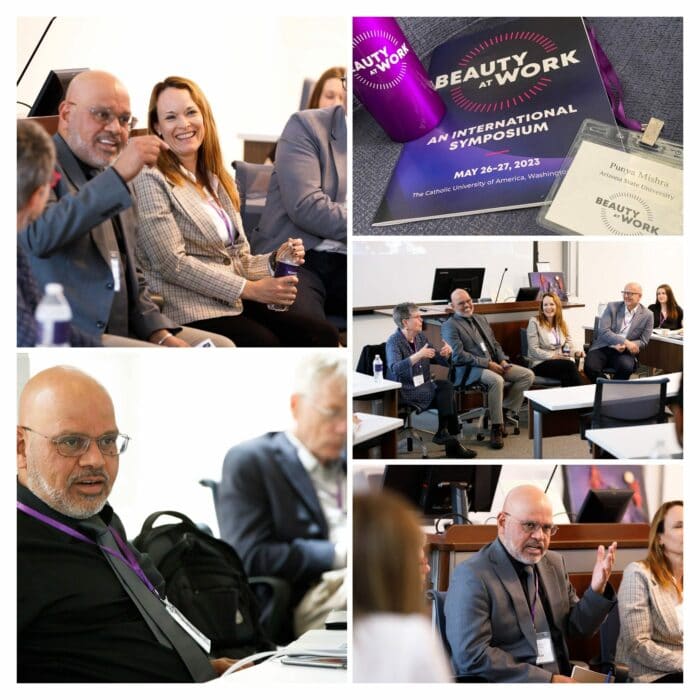
Some photographs from the symposium
Topics related to this post: Conference Presentation

A few randomly selected blog posts…

Reimagining conteXt in TPACK: New article

Reimagining conteXt in TPACK: New article

Back in September I wrote a long-ish blog post about something that had bothered me for years and years about the canonical TPACK diagram. It had to do with how contextual knowledge was represented in the diagram, or rather how it was not represented in the diagram....

Educational Technology @ MSU

The Educational Psychology and Educational Technology program at the College of Education at Michigan State University offers a variety of programs in educational technology. The College of Education is one of highest ranked colleges of education in the country (see...

Designing for anticipation, Teaching for anticipation

In a couple of previous posts I had talked about the idea of postdiction (see the posts here and here). The argument being that good teaching (among a long list of other good things) is postdictable, i.e. it walks the line between predictability and chaos, and most...

The role of Vitamin D in beta-cell function

Who says scientists can't have fun. I just discovered a series of videos on (where else) YouTube about scientists expressing their doctoral research through dance!!! What can be cooler than that? Check out one of the winners: The role of Vitamin D in beta-cell...

Another New Year’s card

We just created another New Year's Card / Video. Check it out: Shreya's Magic Touch [youtube width="425" height="355"]http://www.youtube.com/watch?v=MOrRsXaFE3o[/youtube]

The attention economy and the future of education

Peter Hershock is an education specialist at the East-West Center in Honolulu and author of Buddhism in the Public Sphere. He was recently interviewed by Matt Bieber of The Wheat and Chaff. I found this interview fascinating, particularly the first half which spoke to...

Recreating D-Day…

... on a shoe-string budget. Three designers and a big empty beach, see the results! http://www.youtube.com/v/WRS9cpOMYv0

TPACK and new literacies

Over 150 years ago Herbert Spencer wrote an essay titled What Knowledge is of Most Worth in which he bemoaned the fact that most of the discussion around what is worth knowing in his day and age was based not on any rational discussion of the issues and the benefits...

The art of having it both ways!

The art of having it both ways!

Do I contradict myself?Very well then I contradict myself,(I am large, I contain multitudes.)~ Walt Whitman; Song of Myself, 51 Last week I published two blog posts on the same day, which is relatively rare – but it does happen. What is truly rare is that in these two...

0 Comments

Submit a Comment

Your email address will not be published. Required fields are marked *