WHY: The most important question of all

by | Monday, November 02, 2015

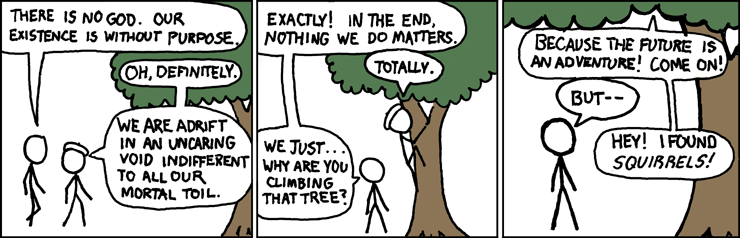
Why do anything at all?

This blog post is a collection of videos and images that I have collected over time that speak to the pointlessness of trying to find an answer to this question and how one question, even if answered, leads to many more. This is the kind of stuff that brings together Feynman, xkcd, Louis CK, and some brilliant animation all on one page. Enjoy.

Lets start with a short animated film called “The Missing Scarf.” Soham saw it during his freshman year (as a part of a class on writing) and shared it with me. It is an amazing piece of work, beautiful but ultimately nihilistic (and though there is a squirrel, there is little joy at the end).

Next up is Richard Feynman, in his own inimitable way demonstrating just how down a rabbit hole we go as we start asking why. He begins by starting to explain magnetism, and then the fun begins.

And there are three different riffs, on the same idea by Louis CK. The first is from his show Lucky Louie:

https://www.youtube.com/watch?v=sahSAMj8OIY

The next the same idea this time as part of his standup act – so the language much more raw, but the overall effect a lot funnier.

https://www.youtube.com/watch?v=BJlV49RDlLE
why

Finally, for his writing class (the same class where he saw the “Missing Scarf” video) Soham had the choice of either writing a paper or making a video. He chose to make a video. Here is his take on THE question: why do anything at all? Enjoy.

Topics related to this post: Creative Work

A few randomly selected blog posts…

Handbook of TPACK for Educators, 2nd Edition

Handbook of TPACK for Educators, 2nd Edition

The TPACK framework, as we know it today, was first introduced to the world in 2006 in an article in TCRecord (Mishra & Koehler, 2006). An important part of the story of the success of the framework was the publication of The handbook of technological pedagogical...

Incredible !ndia

Patrick Dickson sent me this link to an article on Boston.com titled Scenes from India. As the article says: India is home to over 1.2 billion people of wildly varying religions, cultures and levels of wealth.... Though there's no possible way for these images to be...

TPACK Newsletter, #6 Jan-Feb, 2010

TPACK Newsletter, Issue #6, January/February 2010 Welcome to the sixth edition of the TPACK Newsletter, with 642 subscribers (representing a 13% increase during the past 2.5 months), now appearing twice each fall and spring semester. If you are not sure what TPACK is,...

Why ChatGPT Isn’t Your Next Teacher

Why ChatGPT Isn’t Your Next Teacher

There is a great deal of buzz about how generative AI (GenAI) can transform education—something I have been thinking about a lot as well. That said, I not so sure we're asking the right questions. Let's back up a second. Back in the early 90's I was a grad student at...

Wordclouds, mathematics and building a better teacher

Wordclouds, mathematics and building a better teacher

Wordcloud created from all the words in the wikipedia page for "mathematics education"  What does a teacher need to know to intelligently integrate technology in their teaching? Or better still, what is it that teachers need to know to become effective...

A pome a day

Greg Casperson is a graduate student in our Ed Psy & Ed Tech program. He has been engaged, over the past few months, in the most interesting experiment. He carefully selects and posts to his website one poem every day! Greg's RSS feed has become one of the first...

Like to learn, but hate school

In this TCRecord piece, Daniel T. WIllingham uses what we know about cognitive psychology to explain  Why students don't like school. He suggests that although most people believe that humans are good at thinking, it is actually the weakest of our mental faculties......

Autonomy, mastery, purpose

This presentation of a talk by Daniel Pink has been making the rounds on the Interwebs. I am including it here just as a personal reminder for me to use in my teaching AND as an example of a wonderful presentation style. Check out RSA Animate - Drive: The surprising...

Amruta Patil’s Family Album

A few weeks ago I had featured Nina Paley, animator and story teller. I just discovered another amazing talent: graphic artist Amruta Patil. I got know Amruta through the desi blog ultrabrown which recently featured an interview (Amruta Patil and Kari: A short Q&A)...

3 Comments

  1. Sean Nash

    Entropy rules in the universe, and yet life seemingly runs against this gradient of disorder temporarily leaving behind a trail of increased order behind us as we go.

    In and of itself this is a really beautiful thing. I wish I were a better artist. I think it would be easier to paint this concept than to write about it. I somewhat feel like this is exactly what has always guided the lens of my camera.

    Wait… I actually just checked, and this is true. Instagram confirmed it. 😉

    Reply

Submit a Comment

Your email address will not be published. Required fields are marked *