
Ambigram.com is a website about ambigrams and the people who make them. Lots of cool stuff for enthusiasts and novices alike. They often conduct competitions and other fun challenges for readers. One recent one was related to palindromes. In brief, they challenged people to create palindromic ambigrams. This is something I had tried a few time a long time ago – but their challenge pushed me to go back and come up with some solutions.
Well, I ended up with more than I had anticipated. I now have a technique, using which, anybody can create a palindromic ambigram of any length! How cool is that.
What is a palindromic ambigram you ask? A palindrogram? An Ambidrome? People often confuse between palindromes and ambigrams. Both are forms of wordplay that depend on symmetry. Both have to do with writing words such that they can be read in multiple ways. But that’s where the similarity ends. Palindromes are words, phrases or sentences that can be read forwards or backwards, (“No x in Nixon” or “Madam I’m Adam” being two famous examples). Ambigrams are a kind of visual pun, where the shapes of the letters can be interpreted in two or more ways.
A good way of thinking of the difference between the two is by looking at a few examples (or non-examples). Consider the word “palindromes.” As it turns out, the word “palindromes” is NOT a palindrome. Reading it backwards actually gets you a somewhat unpronounceable “semordnilap.” (Just as a aside, “semordnilap,” unpronunceble though it maybe, turns out to be a neologism that stands for words that can be read as two different words, backwards and forwards. This is in contrast to palindromes that read the same when read backwards or forwards. The word “dog” which reads “god” backward is a semordnilap!)
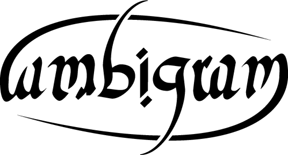
However most palindromes (and semordnilaps) are not ambigrams. Ambigrams, are words that can be read in multiple ways – rotated, reflected etc. Here is an ambigram for the word ambigram. It reads the same when rotated 180 degrees.
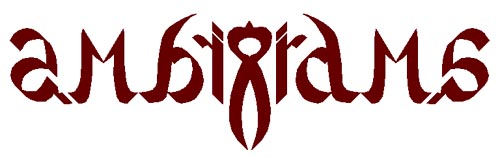
Here is a reflection ambigram, this time for the word “ambigrams.” This reads the same even when reflected in a mirror.
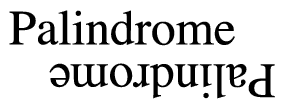
Note that the words ambigram (or ambigrams) are not palindromes. Neither are they ambigrams when not written in a special kind of way. So the way “ambigram” is written in this sentence is not readable when rotated 180 degrees. We had mentioned that the word “palindromes” was not a palindrome. But can it be an ambigram. Here is what it looks like when rotated by 180 degrees. Not very interesting is it?
 Now look at this image below:
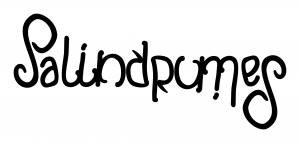
With some visual manipulation, we now have the word “Palindromes” written in a manner such that it reads the same, right side up, or rotated 180 degrees. We now have a ambigram of the word palindromes.
So if we are to differentiate between palindromes and ambigrams, I would say, that palindromes are essentially a form of verbal wordplay, while ambigrams are a form of visual word play. Also, how a word is written (font or style) doesn’t matter in the case of palindromes. Of course the style of writing matters a great deal in the case of ambigrams.
There have been some attempts to combine the two, i.e. create words that read the same backwards and forward AND are symmetric in terms of rotation (or reflection), and this is the crux of the latest challenge on ambigram.com. They want to know if one can create a design that is both an ambigram AND a palindrome. Here is what they say:
We wanted to add a whole new level of challenge to creating an ambigram…
Here is the challenge: Try to create an ambigram that is also a palindrome (or a palindrome that you can turn into an ambigram). If the ambigram says something different upside-down, of course, that ALSO must be a palindrome.
You get the idea… Nothing but ambigrams and palindromes.
They worked on it and as they themselves say, they “set the bar pretty high right out of the gate.” They created a palindromic ambigram where,
Both the upright and inverse phrases are palindromes that can be read forward and backward, and the entire ambigram rotates to become the opposite phrase.
Here is their solution.

Which reads, “Live Not On Evil” one way and “Dogma I Am God” when rotated 180 degrees! Pretty cool.
I have previously tried creating ambigrammic palindromes (or palindromic ambigrams), with modest success. The easy ones are words like Anna.
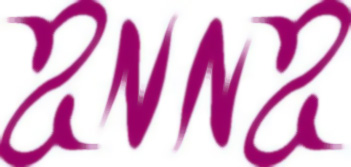
The recent challenge pushed me to try some more, and in that process I have discovered a trick that will allow you to make any word into a palindromic ambigram. That’s right, any word, phrase or sentence, however long the sentence may be. To give due credit, this trick builds on something I had read many years ago in Douglas Hofstadter’s collection of essays he had written for Scientific American.
The trick Hofstadter wrote about was not about ambigrams but rather about creating palindromes of any length. The heart of the trick is the palindromic statement “sides reversed is.” Once you notice that this is a palindrome it is easy to create a palindrome of any length. All you have to do is write out the word, phrase, or sentence, follow it by “sides reversed is” and then repeat the word, phrase, sentence in reverse order. And lo, you have a fully functioning palindrome.
As an example consider this palindrome:
“Power” sides reversed is “rewop.”
Now we could replace the word “Power” with a statement of any length and we have a recipe for creating a palindrome. So we could say:
“Eating jam is hopelessly neurotic” sides reversed is, “citoruen ylsselepoh si maj gnitae.”
So you see what the trick is. “Sides reversed is” is a palindrome, one carefully chosen to mean the “act of flipping or reversing.” So anything we place ahead of it will map onto anything we place after it – as long as we take care to reverse the letters carefully.
With this trick in mind, I decided to take it to the next level. I reasoned that if I could create an ambigram for “sides reversed is” I could, theoretically create ambigrams of any length that were also palindromes. Here is my solution to creating an ambigram for “sides reversed is.” (I use two different colors just to distinguish the words, they are not really needed!)

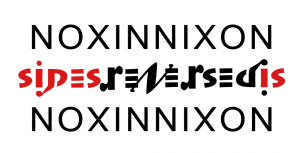
This palindromic ambigram is key. Once we have this, we can create ambigrams of any length whatsoever by sandwiching these words between two ambigrams. Let us first go with the somethat natural palindrome “No X in Nixon” and convert it into a palindromic ambigram. Check it out below. It reads “NO X IN NIXON sides reversed is NO X IN NIXON.” While this design may not win awards for clarity of expression, or for even its truth-value, it is something that can be read backwards and forwards AND even when rotated 180 degrees! How cool is that.
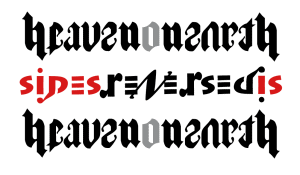
Here is another one, this time stating “heaven on earth sides reversed is heaven on earth.” Again not earth-shattering in its insight but a cool design all the same.
Of course once we have done the heavy lifting (i.e. designed the ambigramic version of the palindromic sentence fragment “sides reversed is”) there is no reason to even sandwich it between ambigrams. So here is an example of how once we have the ambigram for “sides reversed is” all we have to do is sandwich this design between two sets of sentences. The first written the right way and the other rotating it 180 degrees.

Or this (the same as the above but a little more stylistic!)
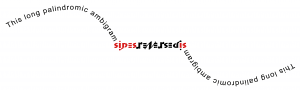
So there you have it, a technique for creating infinitely long ambigramic palindromes!! Enjoy 🙂

Maybe someone will come in handy: https://www.ambigramania.com/
This is one of the ambigram generators discussed in the article.
In fact, there are a lot of them and they are very similar, this one was just in the top of Google, lol
I’m wanting to have ‘keep smiling’ and ‘you got this’ tattooed on my wrists but I would totally love it if they could be read both ways. I have no idea how to do this. Can anyone help?
can someone please suggest a ambigram for my company name RASKIN, i would real appreciate it
Hi punya i wanna make name plate for me and my better half in palimdrome. Our names are Ankit and hetal. I hope u cane help me out.
Thanks.
Looking for help! Wanting to get a tattoo of an Ambigram, the sentence is ‘Hope is a beggar’……..must have spaces….would this be possible?
Sorry Jamie, I don’t do ambigrams on commission. This is something I do for fun. Thanks ~ punya
I wouldn’t call them ‘true’ ambigrams.
Sandwiching your ambigram of ‘sidesreversedis’ between the same phrase rotated 180 degrees is a lethargic attempt at a ambidrome. Although your ‘heavenonearth’ would work in a straight line, Ambigram.com’s ‘livenotonevil’ is still the best i’ve come across.
Wtf? I didn’t get a WORD of this… How the heck do you draw the other palindromic ambigrams? No one gives a crap about your “side reversed is”… :/
I just read all this and it’s 6:56 pm. I wish i had known earlier today.i taught palindromes to second graders and it helped them with learning addiction. And it has the aha factor. I’m a retired el.ed. 84 in January. Last year discovered Mandelbrot’s Fractal set. And seeing fractals everywhere. Fibonacci us my hero. And the Indian mathematicians taught the Greeks and Romans to accept zero and infinity. Of course I already knew Fibonacci brought us Arabic Numerals.
I’m a happy camper.
Also an aside Aristophanes is my favorite playwright.
Thank for my knew knowledge ??
Thanks Mark for the prompt response. I had fun doing this, all prompted by the challenge on your site. Keep up the good work.
What an amazing article, Punya. I do believe that you’ve put more effort into creating “Palindrograms” than anyone else on the planet (well, besides us, of course :-).
By the way, I like that term: Palindrograms. It’s got a nice flow to it.
That “sides reversed is” is an interesting technique, and technically, always true.
Did you see this one?
http://gbnotes.blogspot.com/2009/02/no-x-in-nixon.html