

The long view
Run the tape from cave walls to ChatGPT and the pattern holds. Writing let us externalize memory and made knowledge feel permanent — and from that one property of immutability we eventually got citation, copyright, and the very idea of plagiarism. Print helped catalyze the Reformation and the Scientific Revolution. Radio and cinema changed the shape of public life; television, as Postman warned, made entertainment the natural format for everything, politics included. The internet and social media handed everyone a printing press, and with it the attention economy, the echo chamber, and meme politics. Each new medium changed not just what we could say but how we think.
The papers behind this theme are in the Scholarly Record, my full publication record built from Google Scholar.
AI, the deepest case
Generative AI is only the latest place these questions land. It shares the generative, interactive, adaptive, ubiquitous, and multimodal attributes that make any cultural technology powerful (Mishra, Warr & Islam, 2023) — but it adds one property of its own: it is mutable where print was fixed. And, most disorienting of all, it feels like a someone. Our Stone Age minds are built to find agency wherever something answers back — beavers will build a dam over a loudspeaker playing the sound of running water; we confide in a chatbot. Anthropomorphism is simply AI’s version of that older, wider pattern — one instance, not the whole story.


The close
Which is why I’ve come to believe real literacy, in any age, has two halves: reading the nature of the medium, and reading our own minds — the instincts and biases it plays on. To thine own mind be true. The hardest thing to interpret has never been the technology. It’s ourselves.
Where to start — the canon

To Thine Own Mind Be True: Understanding Cultural Technologies, From Cave Walls to ChatGPT
Mishra, Oster & Henriksen (2024) · TechTrends · the spine of this page

Technology, Representation & Cognition
Mishra, Spiro & Feltovich (1996)

Does my wordprocessor have a personality?
Mishra, Nicholson & Wojcikiewicz (2001/2003)
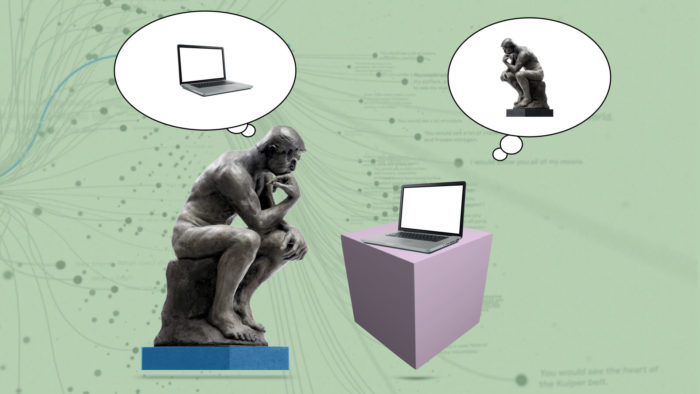
Can a computer program be sentient?
Blog post, on Topffer’s Law and interactive media
The work
 The Peacock & The Chatbot: Hollow Signals & the Trouble with AI TutorsOct 1, 2026Why don’t students use AI-based tutor-bots? Holt calls this the 5% problem: only about five percent of Khan Academy students…
 100 Authentic Followers To Die For [new hyperlinked.us essay]Sep 21, 2026Hyperlinked is a collaborative book that Raaghav Pandya and I are writing at hyperlinked.us. Each chapter starts with something from…
 Fourteen years, 77 columns: Looking back at our TechTrends seriesSep 19, 2026Since 2012, Danah Henriksen and I, along with the Deep-Play Research Group, have been writing a regular column for TechTrends.…
 The Meaning of Silence: Hollow Signals and AI TherapySep 18, 2026Danah Henriksen and I recently finished the latest column in our TechTrends series, a piece on what we call “hollow…
 Value in an Age of AI (Part 1): Revisiting Kevin Kelly’s GenerativesSep 18, 2026Note: Eighteen years ago, Kevin Kelly wrote an essay titled “Better Than Free.” In this essay he focused on the…
 No one is immune: An Update on AI as a Psychological TechnologyAug 28, 2026I blog about a lot of things. Some posts are just updates on talks and publications, a public record of…
 Raising Independent Thinkers in the Age of AI: WebinarAug 27, 2026A week or so ago I was invited to an #AskTheExperts webinar on Raising Independent Thinkers in the Age of…
 Catching Up on Summer 2026Aug 19, 2026It has been a busy summer. On the personal front, my son got married, and the wedding was everything such…
 The Mirror and the Black Box: AI Metaphors and What They Mean for LearningMay 23, 2026The latest installment of the Rethinking Technology & Creativity column in TechTrends is published. This one, co-authored with Danah Henriksen,…