Happy 2020 (& and new video)

by | Sunday, December 29, 2019

We have been creating short videos to welcome the new year since 2008. This year was no exception. These videos, created on a shoe-string budget, are usually typographical in nature with some kind of an optical illusion or AHA! moment built in. Check out our latest creation to welcome 2020 titled Writing with Light, (created with a budget of zero dollars!).

You can see all the previous years’ videos here. Some of them are quite cool, if I say so myself.

What is going on here? OR How does this work?

This video uses the idea of light painting. As Wikipedia describes it

Light painting, painting with light, light drawing, or light art performance photography are terms that describe photographic techniques of moving a light source while taking a long exposure photograph,

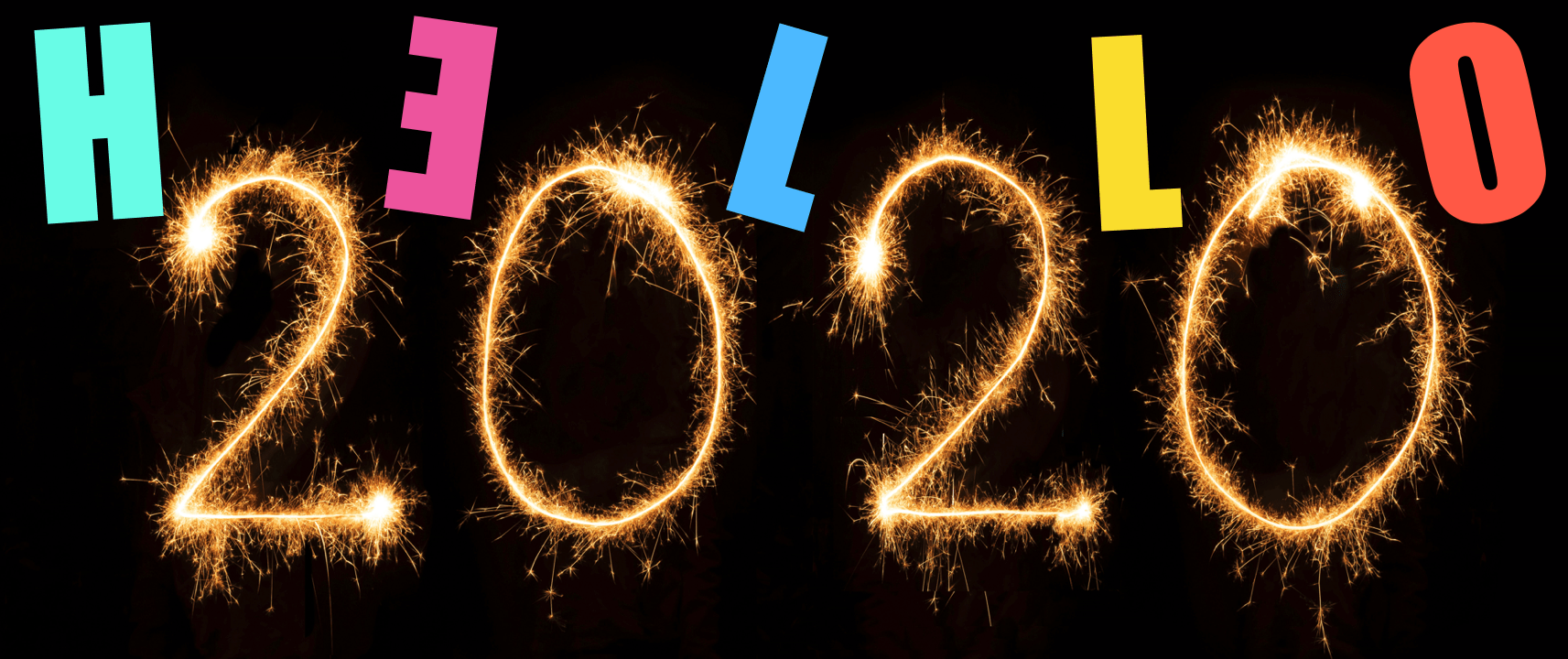
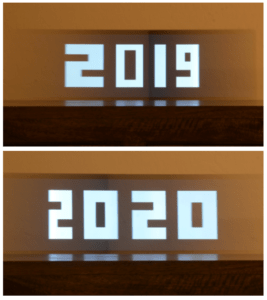
The key here is long exposure, i.e. keeping the camera shutter open for a relatively long time (in this case two shots of 6 seconds each – one for 2019 and the other for 2020) to let moving light create an image. (For instance the banner image above was created by somebody writing in the air with a sparkler.)

This video takes the idea of light painting or writing to another level. It is light painting with an animation! What is interesting is that even though you can see the animation and the entire process, it is difficult to predict what the final image that shows up on the still camera (the one taking the long exposure photo) will look like.

So lets break it down.

The video starts with an abstract animation which is in two parts. (That is what you see at the beginning of the video). This animation, created using Keynote on the Mac, is at the heart of the entire trick. I have extracted them as two animated gifs below. Look carefully, what do you see?


This animation is nothing but the numbers “2019” and “2020” moving across the screen as seen through a slit. Essentially the numbers are in the background, moving behind two black boxes with a gap between them. The two animated gifs below will make it clearer – since I have reduced the transparency of the black rectangles so that you can see what is really going on. All you see in the gifs above are the white portions of the numbers as they pass below the gap between two black blocks.)

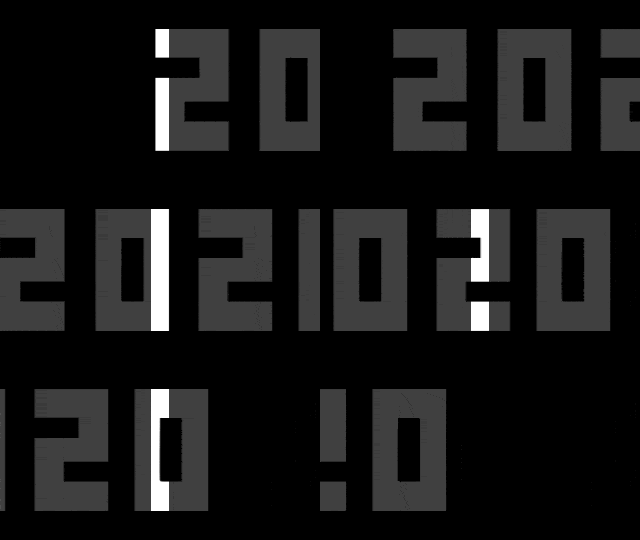
The direction of the movement also matters. Note that 2019 is moving from left to right while 2020 moves from right to left. This is important because it tells us how the laptop is to move with respect to the still camera.

When the laptop moves with respect to a still camera, with its shutter open, the light of the animation “paints” the complete image on the camera—which in this case happen to be 2019 (when the laptop moves left to right) and 2020 (when going in the reverse direction)!

For the shoot, the laptop was placed on a skateboard that could be moved (by someone hiding behind the table) from right to left for 2019 and from left to right for 2020, the opposite direction of the actual animation). The setup is sketched out below.
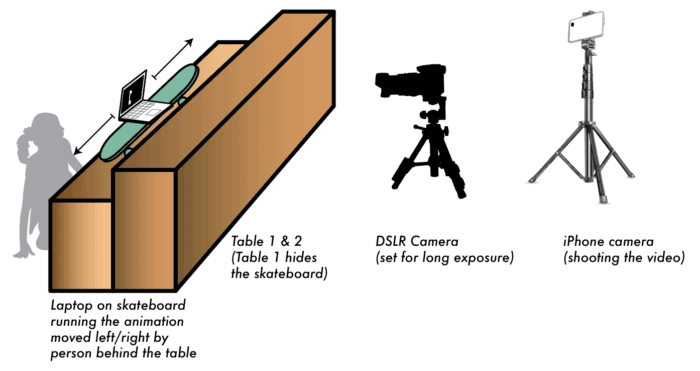
The setup for the shoot

Once the things have been set up, the video camera is switched on and stays on the entire time. The DSLR is switched on twice, once for the 2019 and the next time for 2020, giving us these two images – created by nothing but light. How cool is that!
Topics related to this post: Talk

A few randomly selected blog posts…

TPACK Newsletter #20: May 2014

TPACK Newsletter, Issue #20: May 2014Welcome to the twentieth edition of the (approximately bimonthly) TPACK Newsletter! TPACK work is continuing worldwide. This document contains recent updates to that work that we hope will be interesting and useful to you, our...

Summer Institute for Superintendents, presentation

I was recently invited to present at the 2009 Summer Institute for Superintendents at the beautiful  Crystal Mountain Conference Center in Thompsonville, Michigan. The yearly institute, which began in 1999, is co-sponsored by the MSU College of Education and the...

The (Neil) Postman Always Rings Twice: 5 Questions on AI and Education

The (Neil) Postman Always Rings Twice: 5 Questions on AI and Education

Note: This post has also been cross-posted on the Civics of Technology blog. Marie Heath (with whom I recently co-wrote a blog post about GenAI in Teacher Education: A techno-skeptical perspective) and I were invited to write a chapter for an edited volume titled...

New ambigram logo for ideaplay.org

I had written previously about a blog started by students in our Educational Psychology and Educational Technology Ph.D. program (ideaplay.org) and had designed a couple of ambigrammatic logos for them. You can see the original post here. Here is one of the original...

Happy New Year, from the College of Education, MSU

The college of Education at Michigan State University just came out with a video titled Year in Review. You can see the video below. I would like to point out that a couple of projects I am involved with made it into the video. They include the project with the Azim...

Happy Thanksgiving

Happy Thanksgiving

One updated ambigram (for Thanksgiving) and one new design for the word "Gratitude."   Happy Thanksgiving everyone!

You have been terminated: A case for humane design

You have been terminated: A case for humane design

Good design cares about details. Good design is humane. Bad design is neither. Designers must bring this attention to detail and humanity to every aspect of their work. And this applies even the invisible parts. This, caring for the "invisible" details, is captured in...

Handbook of TPCK

Handbook of Technological Pedagogical Content Knowledge (TPCK) for Educators, Edited by The AACTE Committee on Innovation and Technology
A Co-Publication of Routledge/Taylor & Francis Group and the American Association for Colleges of Teacher Education

Buy it at Amazon.com (Now available!)

This handbook addresses the concept and implementation of technological pedagogical content knowledge — the knowledge and skills that teachers need in order to meaningfully integrate technology into instruction in specific content areas.

Kurt, Mishra & Kocoglu at SITE2013: TPACK in language learning

I just presented a paper based on a dissertation completed by Gokce Kurt currently at Marmara University, Dept. of English Language Teaching, Istanbul, Turkey. Gokce got in touch with me a few years ago as she was preparing for her dissertation. We "met" through email...

2 Comments

  1. Seán Ó Grádaigh

    … & best wishes for 2020 to you and your family Punya!

    Reply
  2. amit upadhye

    awesome idea!! thanks for sharing with us.

    Reply

Submit a Comment

Your email address will not be published. Required fields are marked *