
Structured Improvisation and creativity

by | Thursday, December 22, 2016

Improv(e) Design by Punya Mishra

In this article, in our ongoing series on Rethinking technology & creativity in the 21st centurywe interview Dr. Keith Sawyer, Morgan Distinguished Professor in Educational Innovations at the University of North Carolina in Chapel Hill, and one of the most prominent scholars of creativity. In this interview, Dr. Sawyer speaks to the social and collaborative nature of creative work as a form of structured improvisation. Read the complete article below:

Henriksen, D., & Mishra, P., (2016). Between Structure and Improvisation: A Conversation on Creativity as a Social and Collaborative Behavior with Dr. Keith SawyerTech Trends (61)1.

Note: As anyone who follows my blog knows that I love to play with visuals and typography. The “Improv(e)” visual at the top of the page was one I came up with while writing this blog post. Below the jump are a couple of ideas that didn’t make the cut – but I wanted to preserve none-the-less. In each of these the idea is to convey something about the ideas in the Sawer interview – specifically around structured improvisation. Enjoy.

structured-improvisation

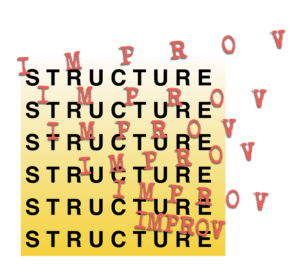
This one is a bit of a visual puzzle but cool none the less. I think this may be my favorite of the three. I didn’t include it at the top because it was taking too much space.
improv-structure-image

A somewhat simplistic approach towards representing Improv and Structure. The design is too literal and just doesn’t hold together very well – but interesting enough for me to want to at least archive it on the blog.


Topics related to this post: Essay

A few randomly selected blog posts…

Gary Marks, Lifetime achievement award

Gary Marks is the director/founder of the Association for the Advancement of Computing in Education (AACE)and also the Executive Officer of the Society of Information Technology in Teacher Education (SITE). As a part of the 20th anniversary celebrations of SITE, Gary...

21st Century Competencies, what are they? New article

Back in June 2011 I was in Paris for EduSummIT: Building a Global Community of Policy-Makers, Educators, and Researchers to Move Education into the Digital Age. EduSummIT was organized by UNESCO (along with other partners) and brought together over 120 scholars,...

On rejection: A mini-rant about current academic scholarship

On rejection: A mini-rant about current academic scholarship

It started with a rejection. That's nothing new - we academics collect rejections like kids collect Pokemon cards (or whatever it is that they collect these days). But rejection, if it must come, must be for the right reasons. This particular rejection hit...

Inside-Out: Happy 2015

Every winter break (for the past six years) our family creates a video to welcome the new year. This is no ordinary video. It requires days of discussion, planning, construction, shooting, and editing. Our videos never feature us (expect maybe a still-shot of the...

Fragility and growth

I just finished reading Haruki Murakami's novel South of the Border, West of the Sun. Having previously read a short story collection and a novel, I thought I knew what to expect, and yet Murakami surprised me. Typically Murakami's stories have a surreal quality....

A year of blogging

It was exactly a year ago, on the first of January 2008, that I began blogging (see first posting here). When I started I wasn't sure how well this blogging thing would work out. Now 12 months and 376 posts later - I have to say that I have truly enjoyed this. I had...

Play—I: Blog post by Team AI

Play—I: Blog post by Team AI

Below is Team AI's blog post for my Human Creativity x AI for Education class. As always, I have not edited their post in any way. You can read the previous posts by following the links here: Post 1; Post 2; Post 3; Post 4; Post 5; & Post 6 This was a great way to...

27 Windows on the Universe (02): The Artifacts in the Machine

27 Windows on the Universe (02): The Artifacts in the Machine

This is the second in a series of posts about the human side of science, based on interviews with 27 leading cosmologists. The first post told the story of how these transcripts came to exist. This one describes how they were analyzed. How the analysis was done I...

0 Comments

Submit a Comment

Your email address will not be published. Required fields are marked *