
I love how these interconnected pipes called the Intertubes lead to serendipitous discoveries. Here are two videos, the first I went looking for, and the second, fell into my lap, so to speak, due to YouTubes related videos section.
The video I went looking for was based on a delightful book I had picked up at a garage sale a few years ago. “The Dot and the Line: A Romance in Lower Mathematics” is a little book (20 pages or so) with an intriguing story-line and its geometrical illustrations. The main character is a straight line who is in love with a dot – but sadly she is more attracted to a wild, unruly squiggle. How the simple line develops his talents and wins the love of the dot is told through whimsical (and mathematically sound) illustrations.
I learned later that the famous animator Chuck Jones had made this into a short film. Here it is (thanks to YouTube).
[youtube]http://www.youtube.com/watch?v=OmSbdvzbOzY[/youtube]
This is just a wonderful example of how mathematics and art, perception and recognition, creativity and design can come together. This book (and the movie) speak to me at so many different levels. What is most amazing is the ability we humans have to see purpose and meaning in the simplest of lines and curves. So much of art and science depend on this ability to perceive / construct patterns.
Nowhere is this more beautifully (and humorously) illustrated than in this other video I discovered. Written and narrated by Mel Brooks (yes THE Mel Brooks) this animated short film, The Critic, takes a different interpretive stance (crankier and edgier) than the previous narration. That this short animation captures, powerfully how we as humans both seek, and question, the meanings of the patterns we see around us.
[youtube]http://www.youtube.com/watch?v=otPkk1sUFkI[/youtube]
I just finished reading parts of Sheri Turkle’s latest book, Simulation and its discontents, and the parallels to what she is writing about and Mel Brook’s Critic are quite strong. The cranky one man in the short recognizes or “sees” meaning is some of the abstract images he sees on the screen and yet he questions their value. The scientists and designers quoted in Turkle’s book echo some of the same concerns.
What is amazing is that the Mel Brooks short was made in 1963, the Chuck Jones movie was made in 1965 and Turkle’s book was published just this year, in 2009!
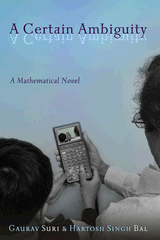 A Certain Ambiguity: A Mathematical Novel is a book written by two of my high school friends, Gaurav Suri and Hartosh Singh Bal.

0 Comments